Internship Description
Dominique Keefe, ‘20BUS, interned with Angaza Design, a social enterprise start-up based in San Francisco. Angaza’s platform solved challenges associated with last-mile distribution, costly customer acquisition, and lack of access to credit for many businesses and end-use customers in emerging markets. The company developed a software platform that allows distributors of products such as solar home electrification kits and clean cookstoves to offer these items to customers on a pay-as-you-go basis. Dominique helped establish a debt fund to finance working capital for Angaza’s distributor partners, enabling them to scale their business more quickly, and conducted a research project on SAAS key performance indicators from the perspective of venture capital investors.
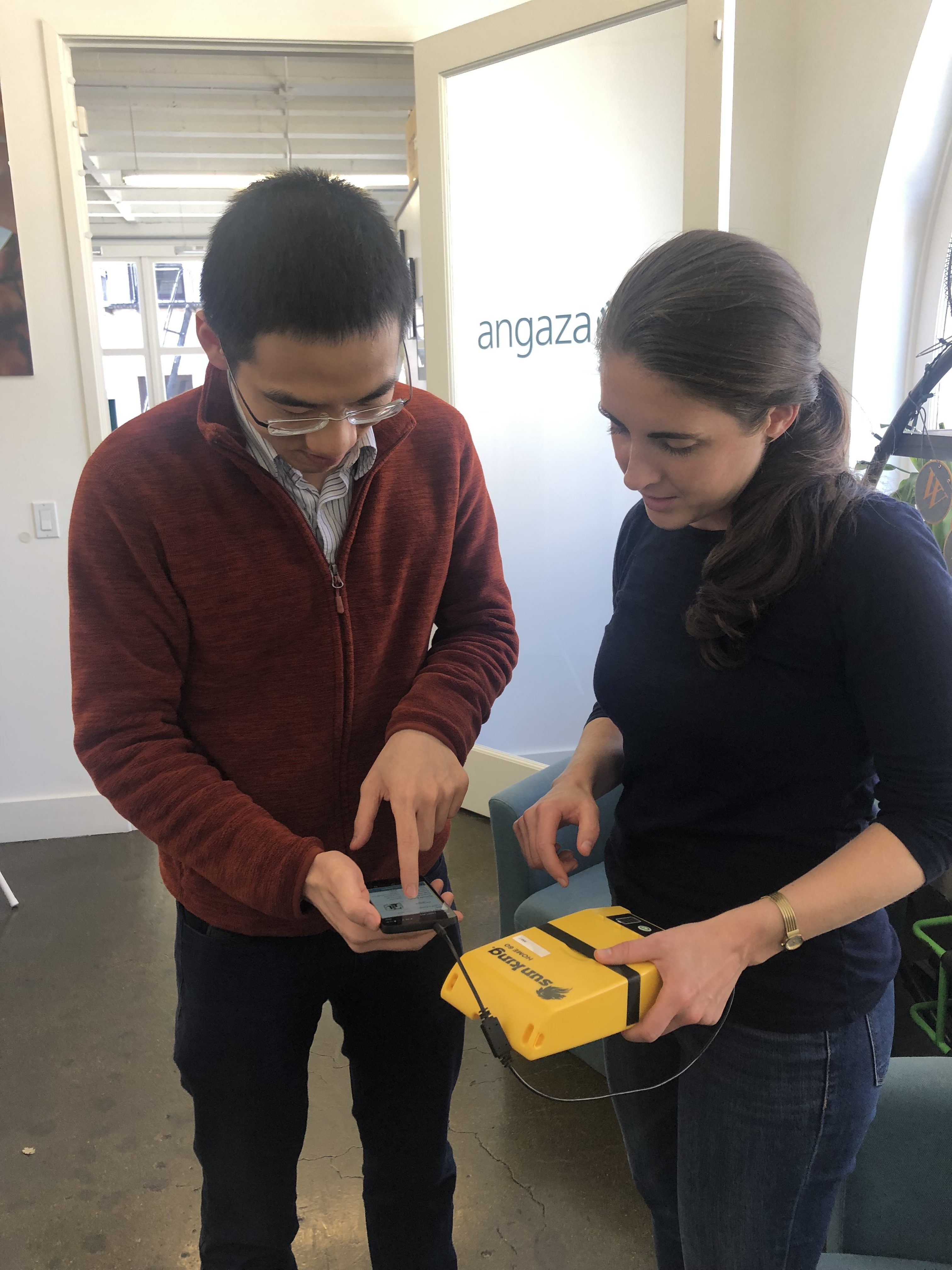
I worked on two projects during my time at Angaza. The first was a project where the company is seeking to work with third-party impact investors, including some large foundations, to establish a working capital fund to provide financing to Angaza’s customers. Angaza’s customers are distributors of hardware devices in emerging markets—types of devices that distributors sell on Angaza’s platform include solar lighting kits, clean cookstoves, water pumps and radios. Angaza’s platform allows distributors to sell these devices to customers on a “pay-as-you-go” (i.e. rent-to-own) basis.
Angaza’s distributor customers typically have little to no access to financing to grow their business. As such, most distributors are extending their customers financing on their own balance sheet. The time from when distributors order and pay for inventory from manufacturers, and when that inventory arrives at the distributor’s warehouse and is sold to customers and then is ultimately fully paid back, can be years. This creates a tremendous drag on working capital, and is typically the largest barrier to a distributor’s growth. The credit gap in financing these distributors is a result of the fact that due diligence is too time-consuming, expensive and difficult to do for these loans, particularly given that the loan size would not be large enough to justify the effort for most lenders. Angaza is developing predictive analytics capabilities using machine learning algorithms trained on the operational data it collects on distributor performance to project future cash flow, and has developed tools to make post-loan reporting and monitoring significantly more efficient. The goal is that these analytics tools will help streamline the lending process for all parties, and would allow the fund to catalyze growth for the distributors.
The second project I worked on was a research project on how venture capital investors evaluate software-as-a-service (SaaS) companies. I used secondary sources and conversations with investors directly to determine which metrics are most impactful in driving valuation, and what is considered attractive performance on those metrics.
My work on the distributor financing project this summer involved creation of a number of investor-facing fundraising materials about the fund, interfacing with potential borrowers to gather due diligence information about their businesses, and working with the business intelligence team to bridge the analytics tools they are building with the traditional lender due diligence process. This allowed me to use a number of skills from the MBA program, including financial analysis, an understanding of the credit underwriting process, an understanding of the different types of impact investors along the risk/return spectrum, and basic statistics skills.
The SaaS metrics research project allowed me to use some accounting skills given that a number of the most often-cited metrics are non-GAAP, but GAAP metrics are also important. It is also often nuanced how financial metrics should be calculated for SaaS companies, so accounting skills helped inform my discussions on this topic as well.
A challenge faced with the distributor financing project is that it is very difficult to structure a vehicle like this to achieve dual goals of catalyzing impact in an area of acute need, and attracting “mainstream” capital that will allow the vehicle (and the resulting impact) to scale. There are a number of nuances and questions surrounding how best to do this. These questions include what the “right” level of return is that needs to be offered to incentivize investors to participate, whether risk is mis-priced in these markets, and how to balance doing something new and inherently risky in order to learn what works and what doesn’t against the need to avoid defaults in early loans in order to attract more investment.
A challenge I faced with the SaaS research project is that there is a wealth of information available online about SaaS startup valuation, to the point where it was difficult to distill it into the most consistent and important takeaways. A second challenge was that Angaza is quite unique in its business model and product relative to the Silicon Valley SaaS companies that it seems the venture capital industry centers its views and expectations around. The venture capital industry unsurprisingly is very concentrated in Silicon Valley and a few other geographic areas, and almost all B2B companies invested in serve US and/or European customers. It was therefore somewhat difficult to try to tie what Angaza is doing to the expectations and viewpoints of the venture industry, because it is serving different types of customers in different markets with a different product than what investors typically look at.
My key takeaways from my summer internship are as follows:
-We need different types of investment than what is standard now to drive solutions to a lot of social challenges. For example, the typical venture capital model involving a 10-year fund with a return target of ~3x the fund in that timeframe, is not always compatible with companies tackling problems that are very complex, that require novel approaches, and that can take longer to scale than a venture capital investor’s 5-7 year time-to-exit requirement would allow. Similarly, traditional debt financing and lender due diligence processes are not compatible with a very large group of well-performing small and medium enterprises in emerging markets, and as a result, there is a credit gap of hundreds of billions of dollars in these markets that is both stifling growth there and causing investors to miss out on these opportunities. Solutions are needed to break down the barriers for allowing capital to flow more freely to areas of high opportunity.
-Angaza’s consumer-financing platform, which combines internet-of-things technology with a customer relationship management platform to manage pay-as-you-go sales, is extremely technically and logistically complex. It is critical though to have solutions like this to allow more people who are off-grid and who do not have access to financial services (like credit), to access products that can materially improve quality of life.
-Angaza has an extremely strong set of company values, and is very invested in people (both its employees and its direct and indirect customers). This is evidenced in how they strive to continually build company culture. This investment in culture and people was notable to me because I’ve never worked somewhere that prioritized these things as much, and this approach really does seem to result in a cohesive, dedicated and well-functioning team.