Internship Description
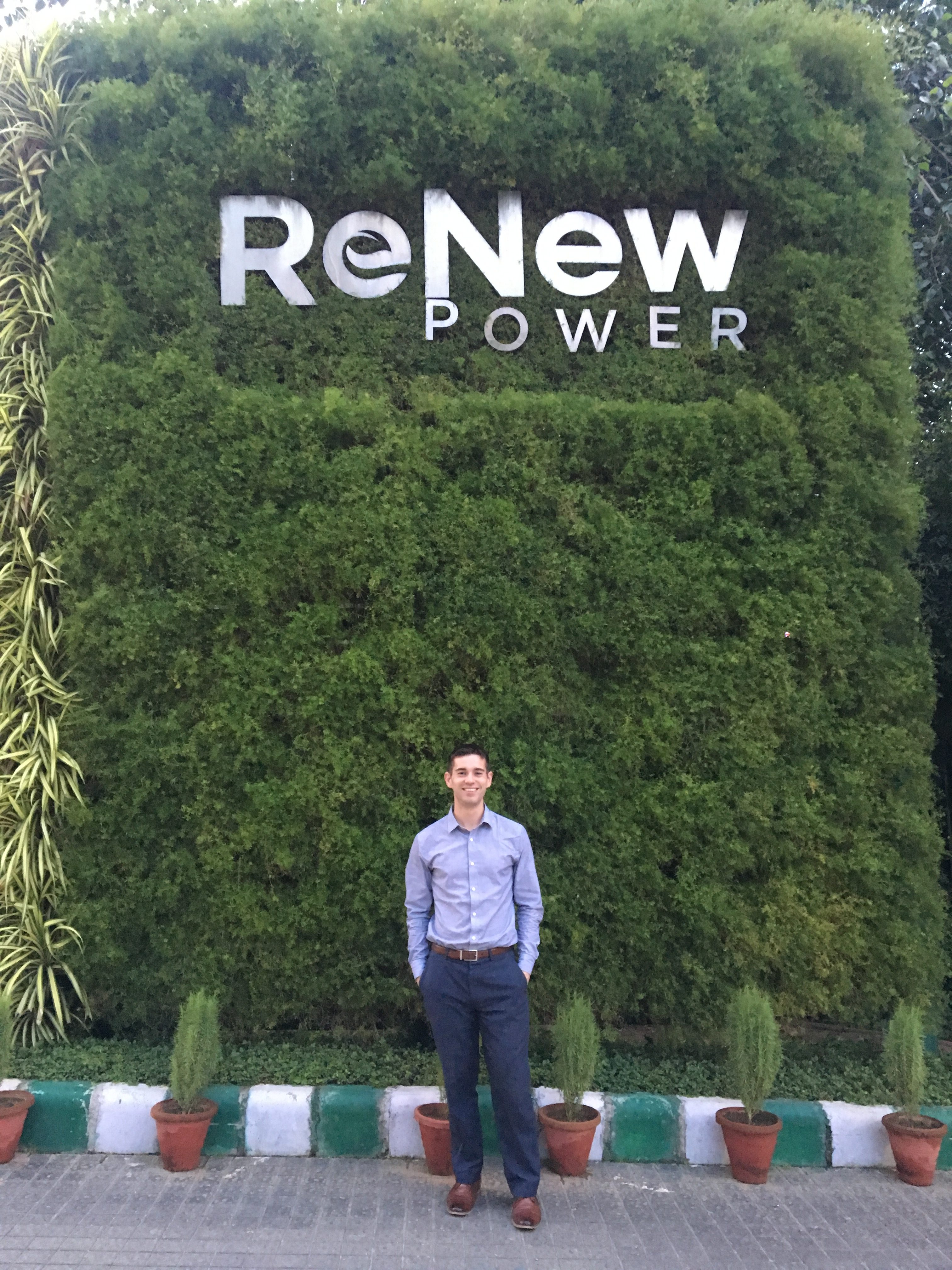
Michael Woods, ‘20SIPA, worked with ReNew Power within their Business Excellence team. ReNew Power is a renewable energy developer and operator based near New Delhi, India, and has scaled from start-up to the largest renewable energy power producer in India. ReNew’s mission is to be a leader in reducing India’s carbon footprint by changing the country’s energy sources. Michael supported this mission by focusing on generator performance, with an emphasis in developing tools and protocols related to asset monitoring, data analytics, and artificial intelligence.
During my internship, I completed two projects to forward ReNew’s mission of providing clean energy. First, I developed financial models for various electric energy storage technologies and policy developments to justify the additional investment in electricity storage systems. Secondly, I developed an executive dashboard to interrelate data across ReNew’s portfolio and operations to create key performance indices.
These two projects worked towards ReNew’s goal of becoming a leading provider of renewable energy solutions and to solve the issues of intermittent power generation.
These projects tackle two pressing issues companies in the energy space are facing, but are particularly pressing in India. Due to issues with grid reliability, electric utilities curtail, or dump, a significant portion of electricity generated from solar or wind power to ensure that round-the-clock resources such as coal or natural gas can operate. Policy and technological breakthroughs are essential to allow for financially feasible storage. The model I developed served to analyze the policy support or innovation needed to cost-effectively turn renewable energy from a supplemental energy source in India into a primary resource.
My second project focused on resolving an issue facing many companies in the transition to a machine-learning oriented operational structure. Many companies have differentiated databases for various job functions, and manual reporting processes. My work developing the executive dashboard and key performance indices was part of ReNew’s pivot to a big-data future.
Through the energy policy and finance program that I am enrolled in, I have further developed my skills and begun to specialize in project finance and policy analysis. In order to fully understand the challenge with storage system deployment in India, I had to rapidly become familiar with the policy context in India. Compared to the United States, India’s policy support for electricity storage is lackluster. There are no additional payments for reliable electricity production, nor are there strong penalties for renewable energy producers for failing to meet their electricity generation promises. The primary motivation for renewable energy producers to implement storage currently comes from utility companies restricting electricity output, depriving producers of their promised revenues.
Columbia uniquely prepared me for this project, as my coursework has focused on renewable energy finance and policy mechanisms. Without this prior training, I doubt that I would have been nearly as prepared to read policy documents, understand evolving policy trends, or develop an effective model to communicate my findings with my supervisor.
The most significant challenge that I faced while working with ReNew largely stemmed from my transition from a professional background in consulting into a large infrastructure firm. In each of my previous roles, data was immediately accessible due to the nature of my engagement with a client company. As the expectations surrounding consulting engagements include urgency and significant expenses, most information that I required was readily available, and those providing the information were easily accessible to help explain any gaps or manual interventions in the data-collection process. Trying to adjust to a professional setting where delays in receiving data can only be partially mitigated, and where that mitigation is dependent on personal relationships, was a personal difficulty.
My primary takeaway from this experience confirmed two premises that I approached the internship with; that I wanted to spend my career working on issues in the renewable energy sector in the developing world, and that a shift towards project finance best suits my skills, ambitions, and interests. The rate of the energy transition in the developing world, as well as the inherent complications in expanding energy access, are exhilarating. Each day of progress while working in renewable energy in India meant an increase in the standard of living and more reliable energy services. It also has the potential for the largest impact in terms of climate change, as these rapidly expanding economies will turn to fossil fuels if renewable energy is unable to meet the needs of a population hungry for energy services. Additionally, these economies are primarily focused on cost; anything that is not economic will not be able to compete. By transitioning to the developing world and a career in finance, I believe I can have a positive impact will pursuing my passion for climate action.
My secondary takeaway from this experience is that I tend to not take the opportunity to enjoy the moment. As described in my previous answers, much of the work depended on interpersonal relationships. Developing these relationships required breaks for chai, as well as snack-breaks in the office canteen. Neither of these experiences originally resonated with me, as I entered with the expectation that each hour should be filled with productivity. As a more personal goal, I am striving to not try to wring every second of productivity out of an hour, but to enjoy the context of my experiences more fully. The SESF program allowed me to not only develop professionally, but to understand and begin to improve on a personal level.