Internship Description
Tara Matalka, ‘20SEAS, was a summer intern with Endeavor Global on their Business and Data Analytics team in their New York office. Endeavor is a non-profit organization following the concept of entrepreneurship as a development tool for emerging markets. The team closely follows the growth of the entrepreneurs in Endeavor’s network, analyzing them in relation to similar companies and other companies in the network, creating data-informed reports and suggestions for the local entrepreneurs. As their dataset grows, encompassing almost 700 Endeavor companies around the world, Tara’s team was tasked to make sense of this data and extract useful insights for entrepreneurs as well as potential investors, taking into consideration the entrepreneurs’ data security concerns.
Endeavor is a non-profit organization following the concept of entrepreneurship as a development tool for emerging markets, with a mission to "select, mentor and accelerate the best High-Impact Entrepreneurs around the world". With its headquarters in New York City being one of its smaller offices, with around 40 employees, Endeavor has 34 offices around the globe, with a strong presence in Latin America, the Middle East, Africa and East Asia. Endeavor aims to foster a stable and prosperous private sector, while granting their entrepreneurs access to a global network of mentors, investors, markets and talent. Working with private sector leaders, Endeavor selects entrepreneurs through local and international selection panels. Endeavor then helps the entrepreneurs build and scale up their businesses successfully, sustainably and ethically, bringing in revenue and jobs to the emerging markets in which they operate. They then encourage their entrepreneurs to give back to the network as mentors and investors. The New York office, as the global headquarter, runs the international selection panels (the final step before the entrepreneurs are allowed to enter the network), and helps facilitate the connections between the entrepreneurs, the local offices and the global network. The global office, in collaboration with the local offices, provides entrepreneurs with greater access to capital, talent and markets in order to help scale up their business. Benchmarks, a relatively new development in the global office, is Endeavor’s internal business and data analytics department. It was started with the intention of making Endeavor Global’s services more data informed.
Every year, the Benchmarks team sends out a long survey to its network of Endeavor Entrepreneurs, asking for information ranging from their current financial performance, compensation packages, growth rates, statistics on their employees and senior management, last round of funding, future rounds, current inventors, operating reach, current challenges and so on. With almost 700 companies having filled out the survey for 2018, Benchmarks had amassed a massive database of information on its entrepreneurs. As a result of some corporate restructuring, my supervisor, Kira Dell, is the only one working on the Benchmarks team, alongside her other position as the Agriculture Vertical Manager, through which she manages all the Endeavor companies that fall under that category. Previously, the team had used the information from the survey to produce simple dashboards on salesforce, displaying general averages and an overview of the statistics. However, the leadership saw little use for this information in Endeavor’s internal functions and were hoping to see the data from the most recent survey used to produce insights and recommendations that will supplement the work of the Endeavor Global staff. My project for the summer was exactly that, to use this database of raw and dirty data to come up with insights or possibly a report, that would prove to be useful to Endeavor and its functions.
I began by looking at the past reports and dashboards to get an idea of what had been done with the data previously. Through the introductory presentations that the different teams gave the interns at the start of the internship, I began to note the functions of these teams and brainstorm ways in which their work could be better informed by the data. I then moved on to the survey. I carefully went through it, noting the type of data being collected, whether it was structured or unstructured, how the questions were phrased, trying to imagine the user experience in order to get an idea of the reliability of the data collected from each field, as well as how much data cleaning will be necessary. I then looked at how the data is stored in salesforce. I was taught how to extract the data to create reports, using logic statements, as I had learned in the course Intro to Database Management. I then began to look at the data itself, tallying the data and familiarizing myself with it, in order to begin the data cleaning process. We were also looking to rewrite the survey for next year in a way that will allow us to collect more structured and clean data, that is consistent with the way data is collected from other sources, as well as eliminating redundant questions in order to shorten the survey, to encourage more entrepreneurs to fill it out in its entirety.
The data cleaning process in itself took up the majority of my time during this internship, as each field that we identified as relevant and reliable had to be cleaned independently as there were specific issues associated with each one. I started thinking of segmentation, and how I will need to group the companies in order to produce analyses that would be meaningful and statistically significant. This was especially difficult since the companies varied in business model, industry, size and country. I began to experiment with different types of data visualizations, using excel and salesforce, in an attempt to identify the best segmentation method.
Throughout this process, my supervisor and I identified different leads that we began to investigate and hope to investigate further. I met with one of my professors, Prof. Yi Zhang who pointed me in the direction of logistic regression as a useful tool for the analyses I was hoping to perform. In between the data cleaning and the redesigning of the survey, I began to read up on logistic regression in my free time, as we have yet to discuss it in any of my classes.
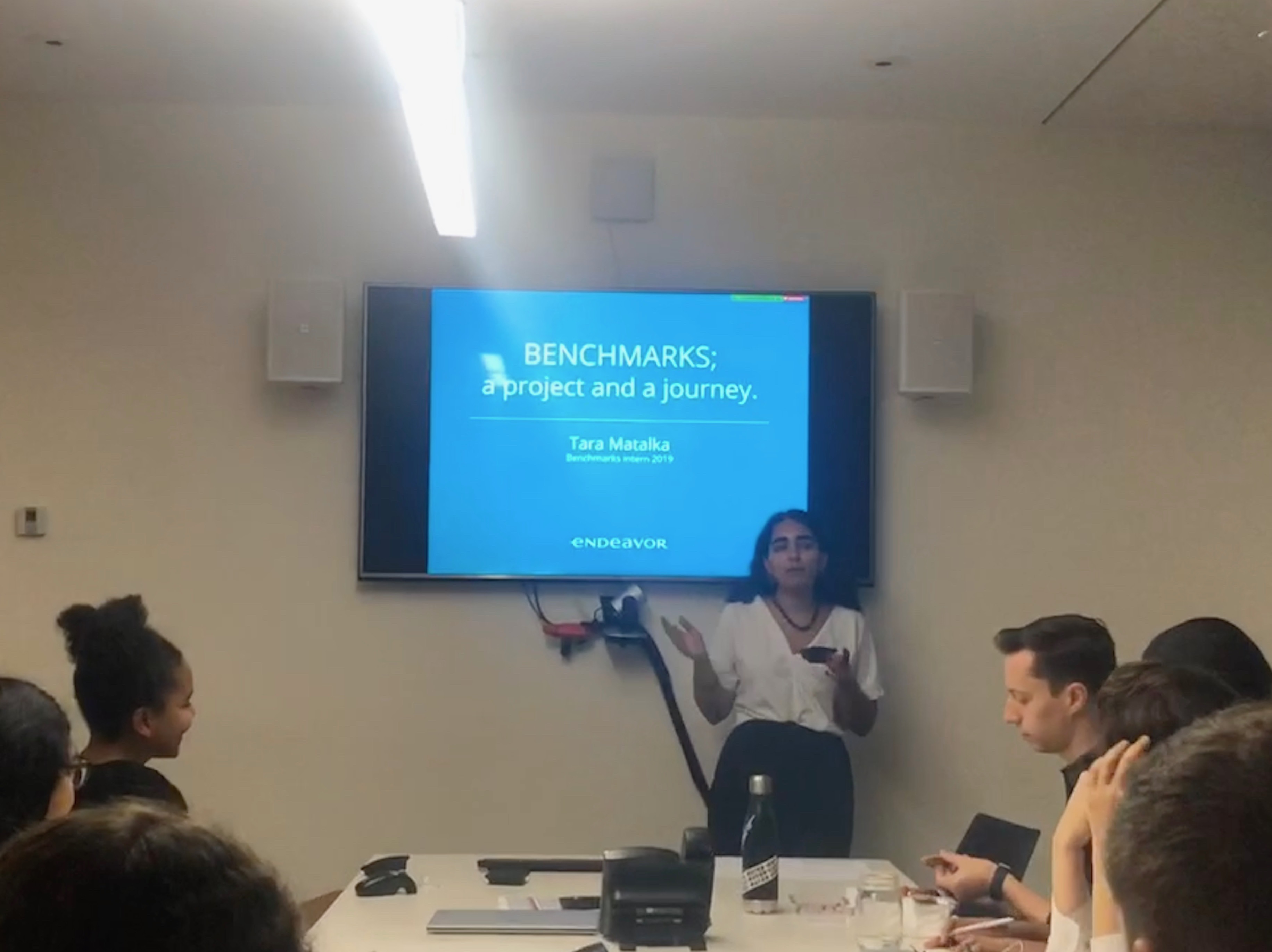
Throughout the internship, we had the opportunity to hear from the founder, the president, a few of the network mentors, some of the entrepreneurs as well as the different teams that make up the Global offices in New York and in San Francisco. At the end of the internship each of the interns was asked to give a 20 minute presentation discussing their projects and their contributions to the organization. However, the duration of my internship ended with hardly a dent being made in grand scheme of the project. I was able to provide a few insights that have already proved to be useful, but I knew there was so much more to `be done in terms of data cleaning, and I had yet to make significant progress on any of the investigation questions we had identified. Therefore, my supervisor asked me to continue working with them during the semester as a part-time intern. Although I will be taking five classes this coming semester, I accepted the offer, as my experience this summer has allowed to realize my passion for data. I have been able to apply the knowledge I’ve gained from courses, varying from Statistics, Data structures, Database management, Quality Control and Management , Accounting and Corporate Finance, Simulation and many more. This internship has reinvigorated my interest in my major and has allowed me to be more proactive in my learning. I am extremely excited to be taking the Data Analytics course, and possibly Business Analytics, this coming semester. I am currently pursuing Data Analyst positions in organizations that I am interested in, and hope to continue working with data and learning how it can be used to inform and improve systems and operations.