


 Francisco Albano
Entrepreneurship in Peru
I probably didn't have the typical or photogenic social enterprise summer experience since I worked primarily in TechnoServe’s office in Lima, Peru – sigh, I had an “office job”.
Although I was technically working "in the field" (new NGO lingo I just learned, meaning almost anywhere outside of Washington), TechnoServe's office in Lima was the HQ for projects located in the Andean regions of Peru and in other South American countries, so no real "field" was anywhere close!
Still I had a terrific experience. I was very curious about working at TechnoServe for two reasons: I thought their approach of small businesses empowerment and value chain creation was a good and sustainable alternative in the fight against poverty. Secondly, I was very impressed by the kind of talent they attracted: the staff was mostly comprised of either actual or former management consultants from top tier firms. I was very curious about how this would play in a non-profit environment. Would these people have the same drive as they probably had in the private sector? Would this make a difference?
Well it certainly made a difference! I was working in the promotion of an Inclusive Business Plan Competition (BPC) for Peru, and on pre-plans for the rollout in 3 other countries. Both of my bosses where ex-McKinsey employees, their boss was ex-Bainer and one of my colleagues was actually working for McKinsey (but on a break after transferring from one office to another). It was inspiring to see how the team was VERY motivated and results oriented. They had set targets for everything (e.g. Number of entrepreneurs that would present their ideas, number of companies founded after the BPC, increase in revenue and profits for these companies, etc), and were, to date, successfully accomplishing these targets.
The first weeks I worked in the promotion of the BPC, to get as many entrepreneurs as possible to present their ideas. I was in charge of semi-massive media (contacting universities, local and regional governments, etc). It was surprising to see the eagerness of local authorities to collaborate in the promotion of the BPC in their constituencies. I even got the opportunity of a one-to-one meeting with a high official of the Agriculture Ministry. We discussed alternative promotion schemes through public networks, but we also talked about the possibility of future projects with TechnoServe.
At the same time I was working in an attack plan for the other countries in which we were going to organize a BPC (Venezuela, Bolivia and Ecuador, the group of countries we called the “Bolivarian bloc”, given Chavez influence on them). I had to gather information of these countries. This led to meetings with other NGOs with operations in these countries, like Ashoka or Avina. With the information gathered in these interviews and other more quantitative information obtained from Internet, I created a plan and had to present it using exactly the same frameworks that consultants regularly use (“horizontal logic” and “vertical logic”, also new lingo form me, but from my first internship this summer).
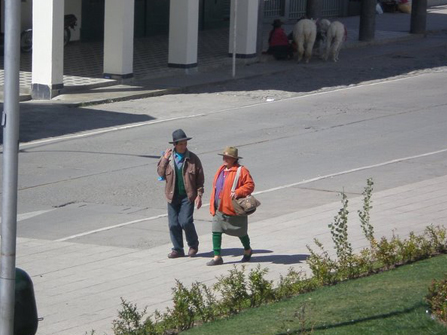
After this presentation I experienced one of the highlights of the internship: I finally put my feet "on the field". I was sent for a week to Huaraz, on the Andean highlands, to help TechnoServe consultants give advise to local small businesses. This experience rocked! I got to meet the local entrepreneurs and hear about their ambitions and the huge challenges they were facing. I was also involved in group discussions on different consulting engagements, like a Marketing plan for a local supermarket, that was threatened by the national chain’s plans of opening stores in the city. Having never worked in business consulting before (nor managed my own business) I was surprised by how much business intuition I could contribute to these discussions (the Core Curriculum unconsciously working its way out?).
The final week was almost entirely dedicated to a screening of the business ideas presented for the BPC. The whole team gathered together in an old colonial house where an NGO connected with TechnoServe has its headquarters. It was long hours of reading business idea after business idea, and providing feedback to the entrepreneurs that had presented them. I was very surprised by the quantity and quality of the ideas presented.
This experience of reviewing business ideas, along with the experience of meeting entrepreneurs in Huaraz, served as a personal confirmation of what I had been reading in the newspapers: something is going on in Peru. I had first arrived to Peru in 2002 and I could definitely perceive a change in the economic environment but also on people’s attitudes. 15 years of sound fiscal and monetary policy seem to have given enough stability for people to finally start venturing, to start exploring their possibilities. This is a great way of making economic growth more inclusive - thus making strides in the fight against poverty. I was very happy with my findings, since I think of Perú as my second home, a place where I lived 3 years and where I ended marrying my Peruvian wife.


