


 Giselle Leung
A Fellowship With Enterprise Solutions To Poverty
One afternoon last fall, shortly after I started my third and final year at Columbia - , on a whim I scribbled on a blank piece of paper elements of my ideal job.
…Challenging and intellectually engaging
…Something non-traditional
…Making a difference, creating opportunities for the poor
…An exciting environment with smart, energizing, inspiring people
…Something that I’m passionate about
The list wasn’t specific, certainly not anything that remotely resembled a job description. But those were the things that came to mind when I thought about an ideal job. This summer, what I capriciously wrote down became a reality when I worked at the start-up organization, Enterprise Solutions to Poverty. And as it turned out, I should have added to the list “Summer dress code: T-shirt and shorts”.
Launched in 2006 by Nancy Barry, former president of Women’s World Banking, Enterprise Solutions to Poverty is dedicated to mobilizing leading companies and entrepreneurs in six emerging markets in building inclusive business strategies that engage low income people as suppliers, distributors and consumers of asset-building products. The six focus countries – India, China, Mexico, Colombia, Brazil and Kenya – hold the majority of the world’s poor. ESP is built on the premise that traditional approaches – corporate philanthropy, nonprofit and government programs – have their limits and the private sector needs to be the engine for poverty alleviation. When low income people are actively engaged as part of the business value chain, they are presented with sustainable growth opportunities that can make a major impact on their lives. The goal of ESP is to double the income and assets of 50 million poor people by end of 2012.
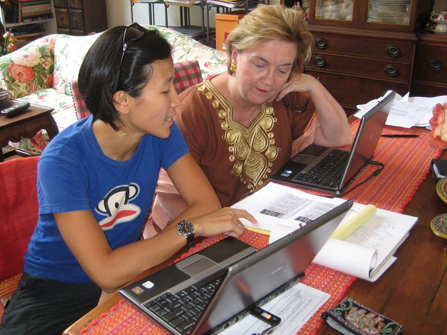
As a Social Enterprise Summer Fellow – and in typical start-up fashion – I worked out of Nancy’s home where, I must add, she generously prepared home-cooked lunches for her team. Over the summer, I devoted my time to building and fine-tuning the ESP budget, working with Nancy to put together the business plan, and developing a strategy to reach out to ESP’s potential strategic partners and funders. It was truly a case of learning by doing, as I have never before built a budget from scratch or worked on a business plan. Unsurprisingly, the learning curve was steep.
I discovered that any real, serious business plan is a labor of love. The 80/20 rule certainly applies, but the last mile to perfection is what really matters – and what really takes up many waking hours.
I realized that drafting the executive summary of a business plan is an exercise (or art?) in wordsmithing. Every word matters in creating a summary that is crisp, clear and succinct.
Last but not least, I learned about the various inclusive business models that some leading companies in India, China, Mexico and Colombia are already implementing to engage the poor. These are not CSR programs, but profitable approaches that are win-wins for all parties involved.
The private sector obviously yields enormous power in our global free market, and it is really exciting to see the beginning of what I hope – and believe – will be a movement that taps into the private sector’s potential to create growth opportunities for the poor, raising their standards of living for the long haul.
My summer fellowship has come to an end, but my adventure with Enterprise Solutions to Poverty continues. I will be transitioning to a full time role with responsibilities of managing strategic relationships with ESP Global Champions (ie: leading global companies and related foundations committed to supporting ESP strategically and financially) and our fundraising efforts. And for as long as I can, I’ll keep that summer dress code.


