


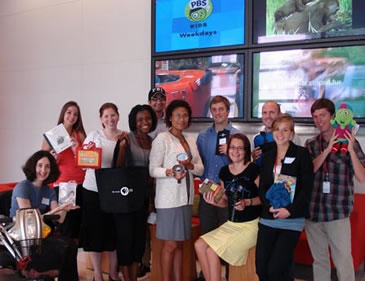
 Anna Pakman
A Fellowship with PBS Kids
When my family first moved to the United States from Russia 20 years ago, my first teachers took the form of strange creatures prancing across my television set. It was through the characters and worlds that appeared on trusty Channel 13 - WNET, the PBS station in New York City, that I first learned English. When I got the opportunity to spend my summer internship with PBS (short for Public Broadcasting Service) in their PBS Kids division I was thrilled to say the least.
PBS is a non-profit provider of public television services and reaches 99% of television households in the US. Owned by over 300 member stations, PBS acts as a national distribution arm for programs produced by its members as well as independent production companies. PBS Kids is one of America’s most trusted brands, due to its block of highly educational, commercial-free, kid-safe programming targeted to children aged 2-8.
Like many media companies, one of the greatest challenges that PBS faces is remaining relevant in a time defined by the emergence of the Internet as the platform of choice for media consumption. Over the course of the summer I’ve been charged with launching an online video service for the PBSParents.org site, which itself is known as “PBS’ best kept secret.” I’m gathering input from managers across a wide range of departments, selecting programs from PBS’ archives that are relevant to parents of our PBS Kids, talking to producers about securing digital rights to selected programming, and developing the business model that will allow this to be a sustainable venture.
A highlight of my summer internship thus far has been attending the annual PBS Kids Next Generation Advisory Board meeting. The two-day event brought together a diverse group of experts on children’s issues who provided their feedback on department heads’ presentations on current and future PBS Kids initiatives. The event also featured presentations from Marc Prensky, an expert on educational gaming, who took us through the positive aspects of video games; Curtis Wong, manager of Microsoft’s Next Media Research group, who gave us a demo of Microsoft’s WorldWide Telescope Project, an Internet-enabled computer application that allows anyone to explore the universe from the comfort of their computer; and Marina Gorbis, Executive Director, Institute for the Future, presented six future themes relating to media and technology.
Plus I got to meet some of the biggest PBS’ celebrities like Cookie Monster, who I remember spreading crumbs across the TV screen as a child. By driving the launch of a PBS brand into new media, I’m helping continue PBS’ mission of education and entertainment – supporting a major factor in my acclimation to American life.
Journal 2:
Did you know that over 10 billion videos are streamed via the Internet every month? Or that 40% of all moms use MySpace? Researching trends in online media consumption, especially as they relate to parents, has been the story of my life for the past few weeks. That and working on the business model for the PBS Parents video service – good thing I paid attention in Corporate Finance and Managerial Accounting! I’ve also been able to get some great feedback and direction from my mid-summer presentations to the SVPs of PBS Kids and Interactive.
So what else have I accomplished? Well… my play lists are complete and I think I now know the title of every single program listed on PBS’ web site (so if you see me in the hall, test me – I dare you!). I’ve also created an info packet to be sent to show producers that includes a sell page, FAQ, background information on PBSParents.org, and guide to categorizing episodes and clips.
The intern program has also gotten off to a great start. In addition to myself, there are three other MBA interns working in various departments across the company. So far we have had lunch and learn sessions with the Communications and Brand Management departments, toured the PBS Media Operations Center, and attended a Social Media conference hosted by American University. Still to come – breakfast with Paula Kerger, the President of PBS, a tour of the Newseum, and a visit to WETA, the local PBS affiliate station serving the Washington, DC metropolitan market.
Journal 3:
Like all good things, internships too have to come to an end. Much of my time during these last few weeks was spent on giving presentations about the PBS Parents video service to senior management. When looking at the index slide on my presentation, it’s hard to believe I got so much work done because so much of it felt like pure fun. From selecting content and editing a demo reel to creating a revenue model to editing to researching competitive practices and developing strategy, I had the opportunity to apply my many diverse interests to one project. One exciting development was the re-launch of www.PBSParents.org, which is the site on which my project will eventually live.
And I know this will sound cliché, as I too have rolled my eyes at this point in corporate presentations, but one of the best parts of the summer was getting to know and working with the people at PBS. From day one, I was made to feel as I was part of the team. In fact, one of the highlights of my summer was attending weekly Kids Matrix team meetings. Being a non-profit organization with limited resources and an unlimited amount of good ideas, PBS has created cross-functional teams around its Kids and General Audience programming where representatives from each department can weigh in on issues that affect the whole division.
All in all, I couldn’t have asked for a better summer internship experience. I remember sitting in Professor Horton’s office last year talking about my ideal job: a combination of media and strategy and social responsibility; and that’s exactly what I got to do!


