


 Caroline Lundberg
Journal #1
It is the beginning of week three in Nairobi, Kenya, where I’m working with TechnoServe’s Coffee Initiative to help structure and arrange financing for wet mills. The Coffee Initiative is a Gates Foundation-funded program to dramatically improve the incomes of subsistence level coffee farmers in Ethiopia, Kenya, Rwanda and Tanzania. The Nairobi office is extremely pleasant – it has about twenty people, staffed mostly by Kenyans with a handful of expats. The people in the office are really friendly and the coffee in the office is great. TechnoServe also does a fantastic job integrating volunteer consultants (volcons) – virtually everyone came around to introduce themselves and chat for a little bit. The organization also provides a lot of coffee education and I attended a coffee tasting training during the first couple days, which was interesting. Ironically enough, I am not a huge coffee drinker – I prefer Diet Coke for my caffeine fix – but I am hoping to appreciate coffee a lot more after this summer.
Wet mills are machines that coffee farmers need to clean their coffee beans in order to sell them into premium coffee bean markets. Premium coffee bean prices are 15-60% higher than commodity coffee bean prices, so access to this machine makes a huge difference for our subsistence-level coffee farmers. To-date, most of these wet mills have been donated or financed in a one-off manner. I am working on developing the framework to create an on-going financing structure between coffee co-ops, wet mill suppliers, Ethiopian banks, and Kenyan banks. It is a really interesting project and fits in well with my background, since I helped structure and arrange financing at my prior job in private equity.
Arthur, who is managing the Credit Frameworks program, is my boss and is really passionate about this project. During my first week, he spent several hours talking through the key aspects of the financing. He also provided introductions to several people in East Africa who are involved with either supplier financing or the coffee project and who were happy to answer my questions. At the end of the week, we met with one of the suppliers who may provide financing and discussed risks/risk mitigation techniques with him. We also evaluated several scenarios to help our supplier reduce his borrowing costs associated with our program, since the cost of debt varies widely across developing countries and we are providing financing across Ethiopia, Kenya, Rwanda and Tanzania. We agreed to a follow-up meeting during the week of June 15th to discuss the exact structure and terms of the debt our supplier is offering to our farmer groups.
During week two, I flew to Addis Ababas, Ethiopia, to help assist with the financing program there. Of the 30 wet mills that we are financing this year, 20 of them are located at farmer sites in Ethiopia. I principally worked on a financing memo to provide justification for several aspects of the financing program in Ethiopia, which has a particularly restrictive banking environment. Regulations are tight, Inflation runs at 30-40% per year and they have a severe lack of foreign currency – it is a difficult country to do business in, even as an NGO.
We’re now on week three. This week includes a coffee farmer site visit as well as a lot of work on structuring the financing terms for the supplier mentioned earlier.
Journal #2
So it is now week nine and I’ve been particularly immersed in Ethiopian wet mill financing. TechnoServe has partnered with 20 farmer cooperatives, or “clients,” to assist them with getting financing from a combination of supplier loans and local Ethiopian bank loans. It has been an interesting process. These clients have no banking relationships, no credit history, no cash and no meaningful collateral. The supplier loans to our clients need to be individually registered with and approved by the National Bank of Ethiopia. The local banks are actually not incentivized to lend: interest rates in Ethiopia are capped at 12.5% by the National Bank of Ethiopia, despite inflation of 30% annually. Thus, arranging financing for these wet mills has not been an easy process. We are also up against a pretty tight deadline to get this financing in order. The harvest season in Ethiopia is starting September 1st, which is unusually early. We need the wet mills in place at the start of the harvest.
In order to help these cooperatives get financing, we developed 20 different operating models, using key assumptions regarding coffee volume, coffee quality, coffee pricing and operating expenses. This helped us to predict how much cash flow the cooperatives will generate and, consequently, indicated their ability to repay the loans. We shared this information with our supplier, who was satisfied that the cooperatives were sufficiently creditworthy and so we engaged a facilitator to help us register the supplier credit agreements with the National Bank of Ethiopia. We had previously developed the terms of the loans with the supplier, so registration of the supplier credit agreements is the principal gating item on the supplier loan. Separately, we also worked with the company to get manufacturing kicked off and to arrange the shipping schedule for these machines from Brazil to Ethiopia/Kenya.
For the Ethiopian bank loans, we also developed memorandums that contained detailed diligence on the industry and each individual coffee cooperative, which we shared with the more credit-focused Ethiopian banks. Of the fourteen private banks operating in Ethiopia, two banks were receptive to the farmer financing program. We are currently facilitating the process to get lending from these banks. In addition to satisfying diligence requests from the banks, developing legal documents and determining exactly how default works, it is also an administratively-heavy process. These farmers in relatively remote parts of Ethiopia without easily-available transportation need to hold a cooperative-wide meeting to authorize key cooperative leaders to conduct banking transactions, take passport photos of the key cooperative leaders, open bank accounts into which the loans will be funded and sign loan documents in English, Amharic, and other regional dialects at the bank branches. It is not an easy thing to get these tasks accomplished, particularly in Ethiopia. The country generally has a very laid-back approach to timelines.
We are hoping that the loans will be officially approved and disbursed by August 10. Keeping my fingers crossed that the next journal entry discusses loan disbursement to our clients!
Journal #3
It is now my final week with TechnoServe. The assignment has been absolutely amazing. It is legitimately one of the coolest projects with which I have been involved. I cannot say enough fantastic things about the work, the people and the impact of TechnoServe. I also really appreciate that Columbia developed the Social Enterprise Summer Fellowship Program. It is such a wonderful option for the summer internship.
In terms of project progress, things are looking good, although there have been some inevitable additional delays. The National Bank of Ethiopia expressed concerns with our initial application, so we went back to them with some additional documentation. On the Ethiopian lender side, we appear to be in good shape. However, we need to hold several co-operative meetings still and we are finalizing the logistical details of the working capital loan. We anticipate that we will resolve these issues smoothly, although they have moved the loan disbursement date out somewhat.
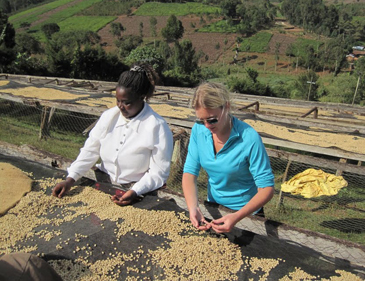
In other news, as my part of the project wound down, I had some time to finally visit a coffee farm and a coffee factory. Despite spending all summer working on financing for these wet mills, I have never actually had time to visit a wet mill—so that was a pleasure. I spent two days in the field learning about how it works and watching the soup-to-nuts process. Coffee factories receive coffee cherry – the unprocessed coffee that actually resembles a small cherry. The coffee factory then mechanically scrubs the coffee cherry, removing the fruit and the slimy mucilage that covers the coffee bean. The coffee bean left is called parchment. This parchment is spread on trays to dry in the sun. After it has dried, this parchment is stored to be sold.
The farmer schedule is quite impressive. I met several of the coffee farmers who were dropping off their coffee. In this particular region of Kenya, farmers generally have cows, tea and coffee. The farmers wake at sunrise to milk the cows, then walk to the milk depositary to sell the extra milk – generally a several kilometer walk. Then they walk back to their farms and pick tea leaves all morning, then walk to the tea factory to sell the tea leaves. Tea is less profitable than coffee, but farmers receive cash upfront for their tea leaves, so it is a good crop to grow in tandem with coffee. Coffee payments are only received once or twice a year, so farmers wait several months to receive cash for their coffee cherry. After selling the tea leaves, farmers return to pick coffee all afternoon and then carry their coffee cherry to the coffee factory. It is a long day with a lot of walking and it is generally done primarily by women, which I found surprising and impressive, given the labor-intensive work and heavy loads of tea/coffee that need to be carried several kilometers.
At any rate, it was a terrific experience all around. Huge thank you to both TechnoServe and Columbia’s Social Enterprise Summer Fellowship Program for the project this summer!


