


 Mike Brown ’11
Journal #1
Community Water Solutions (CWS) is an NGO that builds community‐run, for-profit businesses in rural villages in Northern Ghana that are “off the grid” for piped water. These villages’ only current sources for drinking water are shallow, open, manmade lakes called dugouts. These businesses treat the existing water in bulk and sell the clean drinking water to the community’s households. Profits from the businesses pay for future costs of water treatment thereby ensuring a permanent source of clean drinking water for the village and also earn the village women running the businesses a small income.
My main project for the summer was to create and pilot the CWS Summer Fellowship Program, which is a tuition‐based, three‐week program for which applicants applied throughout the previous semester and whom I had interviewed. The accepted applicants represented different target markets that we thought might be a good fit for future fellowship programs as well as potential full‐time employees of CWS. Five were accepted (two undergraduate students, one college graduate with two years professional experience, and one Sloan student with two years experience with McKinsey). None of the applicants had international development experience. Once those who were accepted, they were sent a welcome packet in which they were informed of their new team members, the timeline for tuition payments, and travel logistics and given materials to help them fundraise for their team tuition of $10,000.
After months of forming the schedule and curriculum for the CWS Fellowship Program, I finally arrived in Tamale, Ghana, where CWS is headquartered, to get all of the on-site preparations done. I spent the first week checking in on each of the existing CWS village businesses, being brought up-to-speed with my Ghanaian staff, and resolving any issues they were dealing with. (These issues are just what I commonly help them deal with. They can range from “daily numbers are low for water sales” to “the rainy season has come, and now the path to the treatment center is flooded in Jarigu.” The latter issue led to us building a second center in the village, closer to the center of the community.) I also went with my partner, Kate, and my two mangers, Peter and Shak, to visit potential villages for our fellows to work with during the program. We decided on Wambong a village of what we estimated was 400 people.
The second week, I spent solidifying the course book and materials for the fellows. This consisted of five PowerPoint decks, some basic tips on the local language, Dagbani, some getting-around tips, a detailed schedule for the three-week program, and emergency contact information. I spent three very full days creating step‐by‐step manuals for our village implementation model and each of its sub‐processes, the timing for these, and any necessary materials for each step. (At a high level, these steps include: Identify Village & Test Water Sample, Schedule & Conduct meeting with Chief & Elders, Build Treatment Center, Train Women, Order Center’s Signboard, Distribute Safe Storage Containers to Village Households, Open Treatment Center, Monitor Sales, Sample & Test Water at Source and through Random Household Visits.) All of these materials were to be included in a binder that we would hand out to each fellow on the first day of the program. On the first day of Week Three, I went around Tamale searching for a working printer to use for all of the notebook materials. I found about 10 printers in total in all of Tamale, two that worked, and both charged the equivalent of $1.20 a page. The notebooks were about 100 pages. Used to such small “crises,” I adapted quickly. I ran to an Internet café and ordered all of the copies I needed through a Staples close to one of my partners in the states. The partner agreed to pick them up and meet one of our fellows at Logan airport before his flight to Ghana the next day. It was a whirlwind, but all worked out in the end.
The rest of Week Three I spent ironing out the logistics for the CWS Fellows while Kate made the long trip down to Accra to meet the Fellows as they arrived at the airport and escort them back up to Tamale. I re‐confirmed all the accommodations for the fellows at GILLBT guest house, the compound where we’d arranged for them to stay for the duration of the program. I arranged their three meals each day for the upcoming three weeks and had the CWS compound cleaned. I also briefed Peter and Shak concerning what the intentions of the program were, what they should expect, and what we expected of them. Finally, I just made our office/conference room ready to accommodate the “class days” for us and the fellows, making sure we had all the necessary chairs, space, etc.
The fellows arrived in Tamale late Sunday night at the end of Week Three. I picked them all up in my truck at the bus station and, after some quick introductions and tired smiles from the fellows, drove them to GILLBT. I quickly showed them around their new home and once they were settled, told them to rest up and that breakfast had been arranged for 7:30 a.m. the next day. I would come by to pick them up for their first day at 9 a.m. This would be their late morning. The rest of the days would mostly start around 5 a.m.
Journal #2
Week 1 of the Fellowship Program consisted of training and getting acclimated to the Tamale area. We spent much of the time in our office. The night before, I spent hours assembling the fellows’ binders from the boxes of printouts one of the fellows had brought with him (mentioned in Journal 1). I barely slept that night; I was so excited/nervous about the big kickoff. I picked up the fellows at 9 a.m. and drove them back to the CWS office. We sat in a circle as I distributed the notebooks and settled in for the first day of the CWS Fellowship Program. After going around the room and having each person give a bit of an introduction, including why they wanted to be a CWS Fellow and what they hoped to get out of the experience, I began to walk through the content in their binders. I prefaced everything with the fact that the fellows were the lucky group to be piloting this program and, as such, I would be soliciting their feedback in evening debriefs throughout the next few weeks in order to improve the current program as well as future programs. I reiterated that the important thing was that we all got something out of the program and came away satisfied. I then gave a preview of the itinerary for the program briefly describing each distinct phase and dove into the first of the presentations.
In general, Week One was more academic and included an overview of international development, the global water crisis, and CWS’s history and approach to water treatment. These were the PowerPoint topics I presented in the classroom/office. We also tried to get the fellows acclimated to the Tamale region in fun ways such as a scavenger hunt in which they would have to dive into the central market as well as really hunt to find some difficult/unique items, such as Coke Lite. The scavenger hunt was a HUGE hit and will definitely be a permanent activity in the CWS Fellowship Program.
Week One also included presentations from three other NGOs —UNICEF, New Energy (a local NGO of mostly engineers that does a lot of very effective work in a number of areas), and The Carter Center, with which CWS has a very healthy relationship and open communication — to give a fuller understanding of international development and how other organizations approach the different issues in the area, including, of course, water treatment. There was one night out that week for dinner with the director of the Carter Center, which the fellows loved and I hope to include in future programs. Week One ended with lab and field training as well as simulated chief meetings, covering the basic rituals and scripts for Q&A, to fully prepare the fellows for their village implementation. We took the fellows out to visit some of our up and running centers so they could see what they’d been learning about in the office firsthand and know what their end goal would look like for their own village project. We also had detailed lab and water testing training. The fellows also visited their village, Wambong, for the first time, took a sample from its water source and scheduled the meeting in two days with its chief and elders.
In the field
The meeting with the chief and elders is, arguably, the most important part of a village implementation and an incredible experience. For the fellows, it turned out to be quite the event with hundreds of villagers joining in by the end. I had the fellows pick one person from the team to do all the talking in the meeting so as not to confuse the translator and to avoid having the chief feel like he was being “attacked.” They picked the youngest member, Ben, who did a fabulous job. (I’m of the opinion that this experience is what caused him to really bring his “A game” for the rest of the program, and he has since presented the Fellowship at his school and recruited fellows for the next program. He hopes to work for CWS in the future.) The meeting was a success, ending with the village agreeing to work with CWS and to deliver on the first three requests that the fellows were required to make in the meeting:
- A list of all the Wambong household names
- The names of two women candidates suited for running the new water center
- A village mason to help with building the treatment center
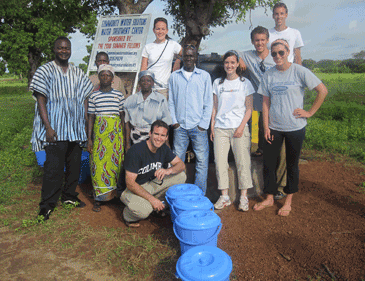
Over the course of Week Two, the fellows, with the help of the village mason, built the water treatment stand, bought all the necessary components of the treatment center and transported them to the village, constructed the center, trained the women in water treatment and money management, and distributed safe water storage containers to every household in the village, educating each household on the proper use and storage of clean water. For the most part the female worked with the village women, and the men built the center and distributed containers. It has been our experience that this is most effective and allows the village women to feel more comfortable and ask questions when they don’t understand something.
Fun
We were lucky enough to be conducting this program during the World Cup! Therefore, throughout these few weeks the fellows got to experience watching World Cup games surrounded by hundreds of screaming Ghanaians, albeit crowded behind either one tiny television improvisationally wired outdoors, or a large hanging bed sheet being projected upon. Before the first game, the fellows all bought Ghanaian soccer jerseys and proudly wore these bright green, yellow, and red shirts to all of the games. They didn’t exactly blend, but they were accepted into the crowd with smiles and open arms!
During the third week of the program, we also went on a day trip to Kintampo Waterfalls, which was a long drive but a great break from the long days and gave us some time to relax. The falls are quite pretty, and there are areas that are deep and still enough for swimming.
Opening Day in Wambong
At the beginning of Week 3 of the program, the Wambong treatment center had its grand opening. The opening of a CWS treatment center is quite the event. The entire village will come out, and there is usually drumming and dancing while people wait to fill their first storage container full of clean water. It is a ton of fun. From the CWS side of things it can be a ton of work as well and can be fairly overwhelming.
As this is the first time the women have run the center, you have to be sure that money is being collected from every person appropriately (many times people forget to collect/pay money) and, as this is the first time the storage containers have been filled, you have to be ready to fix any leaks and tighten any taps, etc. The elders all come out to watch over the villagers and so, you must have your water tests ready to educate any who were not in the original meeting to learn about the wonderful thing they are doing for their village, show them how dirty the old water was and how clean it is now. I ran around doing in the hot sun for hours on end. The fellows did their part as well, recording every household that came to fill its container and congratulating everyone on their new healthy clean drinking water.
The Fellows spent the remaining days of the program monitoring the success of the village business. The majority of successful development projects are spent monitoring and reporting. As such, we felt it was important that the Fellows at least experience some of this in order to truly see all phases of a project. Each day, they would get to the treatment center when it opened at 6 a.m., and half the team would monitor sales while the other half randomly visited households and interviewed the people in each household to solicit feedback about the water from the center, inspected the condition of the household’s storage container, and took a water sample from the container. The second half of each day, after having lunch and resting a bit, half of the team would test water samples in the lab while the other half would return to the village to continue the random household visits. This type of monitoring would continue with Peter and Shak, our Ghanaian staff, for months after the team returned home.
At the end of the third week, my sixth week in Ghana, the day finally came for the Fellows to leave. They gave me a card and printed a picture of all of us together. I was touched. They also bought Shak a goat and Peter a couple of hip hop CDs that they knew he would like. We had all grown very close, and it was sad to see the whirlwind of a project come to an end. I rode the bus down to Accra with three of the fellows. The other fellows decided to pay to fly straight from Tamale rather than put up with another long bus ride. I didn’t blame them. One by one I said my goodbyes. Our first CWS Fellowship Program had been a complete success and all went home with smiles on their faces, some great memories, and many stories to tell.


