


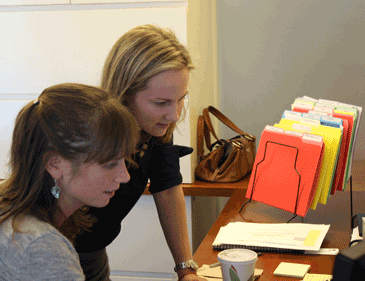
 Jessica Harrison ’11
Journal #1
This summer, I am a summer associate with the Global Impact Investing Network otherwise known as “the GIIN,” which is an initiative primarily funded by and housed at the Rockefeller Foundation. The GIIN seeks to build awareness, the infrastructure, and tools in order to advance the burgeoning impact investing industry, in which investors invest in for-profit companies for social impact as well as financial returns.
One of the first things I learned about the industry through my interviews and research before I began my job is that impact investing is not the same thing as socially responsible investing (SRI). With SRI, investors typically take a ‘do no harm’ approach and as a result, they eliminate companies or industries from their portfolios that they think could be harmful to people or communities, like tobacco company investments. With impact investing, investors are proactively investing in for-profit companies to improve people’s lives in myriad of ways — from microfinance investments to investing in entrepreneurs who are providing basic goods and services to disenfranchised or impoverished people.
In my mind, this is a truly exciting intersection of business and social impact. Impact investing is expanding the capital base available to entrepreneurs who use the funding to have positive and sometimes-transformative impact on people’s lives in a sustainable way — unlike traditional philanthropy, which is dependent on constant fundraising and can be less efficient than typical businesses. It also incentivizes traditional investors to use their expertise to explore new approaches and instruments to improve the world. Impact investing is an innovative and nascent space, and it’s both exciting and challenging to figure out how to grow it.
This summer, I’m working on a particularly exciting initiative called Impact Reporting Investment Standards (IRIS). IRIS was initially conceived of to address a key challenge in impact investing: how do you actually measure and compare social impact across investments? Without a language or indicators to assess social impact, it’s difficult for investors to commit their capital to investments that oftentimes have lower returns than traditional investing. The absence of a common language around social impact also inhibits investors from effectively comparing funds and portfolio companies on parameters other than financial returns. The first version of IRIS was launched in 2009 and was piloted by a number of leading funds, including the Acumen Fund. The second version of IRIS, which I’m contributing to, will be launched at the end of the summer.
What this means, in terms of my summer associate position, is that I’m supporting a number of tasks to develop the second version of IRIS 2.0 and get it ready for launch. My tasks entail helping refine education and agricultural metrics, defining key industry terms, and reaching out to leaders in the impact investing space to get their perspectives on how to optimize IRIS. So far, I’ve had the great pleasure of talking to people at Root Capital, the Kellogg Foundation, and Grey Matters Capital.
Journal #2
The two most exciting opportunities for me to gain exposure to the impact investing space occurred at the beginning of my internship: I attended the Aspen Network of Development Entrepreneurs (ANDE), McKinsey’s impact investing training, and I attended the ANDE metrics conference in Washington DC.
During the second week of my internship, the GIIN graciously paid for me to attend a training organized by the Aspen Network of Development Entrepreneurs (ANDE) at McKinsey for approximately 30 summer associates working in ANDE-affiliated organizations. The training took place over two days, and senior level personnel from some of the leading impact investing funds — including the Acumen Fund, E+Co, and Root Capital — facilitated discussions and shared their work with the summer associate participants. The highlight of the two-day session was a “Zambian Honey” case discussion facilitated by Brian Milder, managing director of strategy and innovation at Root Capital. During the case, all the summer associates were split into different roles, from the Investment Committee to analysts conducting due diligence, and we had to determine whether we would invest in the fictitious company. The case produced really dynamic discussions about requisite returns expectations, social impact assessments, and risk mitigation measures for an investment in a frontier emerging market context. Perhaps most importantly, I met a lot of really interesting summer associates from various funds and NGOs who had diverse professional and personal backgrounds but shared the same motivation and commitment to exploring how to leverage capital markets for impact.
A few weeks after I attended the summer associate impact investing training, I had the opportunity to attend the annual ANDE Metrics Conference, which brings together leading funds, social entrepreneurs, technical assistance providers, and thought leaders in the social impact space. For two days, I met interesting people with very different perspectives on social impact metrics. For example, social entrepreneurs, many of whom are being asked by funders to adopt more rigorous impact assessment standards, were concerned that there was insufficient support (resources, tools, etc.) flowing to them to be able to measure standards. Oftentimes metrics are developed by people in an “ivory tower” or at investors’ offices, who do not proactively seek to understand the unique challenges of measuring impact in resource and information-constrained environments. This sentiment about the need for more technical assistance and resources to actually use the metrics that are being developed really stuck with me. For IRIS and other social impact measurements to be successful, we need to make them user-friendly and provide the requisite resources to the people with the challenging job of tracking them.
During the Metrics Conference, the IRIS team facilitated a few sessions in which we introduced conference participants to the IRIS framework. In these sessions, participants read hypothetical cases that we developed, like “Daisy Dairy” and “Free2bee Honey,” and selected IRIS metrics as if they were the entrepreneurs. The purpose of the sessions was to familiarize attendees with the IRIS framework and help them to understand how to go about select metrics in line with their impact objectives. Ultimately, the sessions were informative, but we also learned that we tried to do too much in a short period of time, and the materials could have been much more user-friendly. It was a good learning for all of us and I especially appreciated the opportunity to support the facilitation with Margot Brandenburg, an associate director at the Rockefeller Foundation. I hope I have the opportunity to work with her in the future.
All in all, the conference was a great way to learn about the players in the impact investing space, the challenges associated with measuring impact, and the unique solutions that people are developing to advance impact assessment. It was also a great opportunity to get feedback on IRIS and what we need to improve for future facilitated sessions as well as the developing the taxonomy. The night finished off with a “metrics bar crawl,” in which we hopped from some of the ANDE members’ offices, like at Agora, to bars answering metrics questions and having drinks.
Journal #3
After 11 weeks of working on the Impact Reporting Investment Standards (IRIS) at the GIIN, my internship has come to a close. Looking back, it’s exciting to see how much I’ve learned about the impact investing space and social impact assessment in general. In particular, there are a few takeaways on which I am reflecting that have shaped my thinking about impact investing and impact assessment:
- Impact investors should not be lumped into “Impact-first” and “finance-first” categories.
Relative to when I started my internship, I have a greater understanding of the key fund managers in the landscape, as well as the different investment philosophies they espouse. Many in the space categorize impact investors into either a “finance-first” or “impact-first” camps. My perception now is that there is much more nuance around impact investment philosophies, and funds would more accurately be depicted along a spectrum between the extremes of “finance-first” and “impact-first.” Virtually all the funds I’ve encountered in my research and personal interactions believe in the unique power of investing to achieve financial returns and social impact; to label the funds into one camp or the other is to obscure the philosophy that impact investing is used as a means to achieve both kinds of results. Of course, some fund managers are willing to take more financial risk in order to achieve impact gains and vice versa, but a delineation of their investment approaches on a spectrum is a more accurate way to communicate those nuanced preferences. - Measuring outputs is an important first step; measuring outcomes is an essential evolution.
One of the most frequently asked questions about IRIS is why the taxonomy falls short of measuring real outcomes and impact. When I began my summer, I was under the impression that a system designed to measure social impact would measure outcomes or at least strive to measure outcomes, in addition to measuring outputs. In fact, IRIS is strategically focused on measuring outputs. The difference between outputs and outcomes is that outputs are typically attributed to an individual organization and can be used as distant proxies for impact, while outcomes are often more difficult to attribute and measure but are much clearer barometers for impact. For example, if you are running an agriculture fund and one of your impact objectives is to raise the standard of living for farmers, the outputs you would likely measure would be the number of farmers served, the hectares of land cultivated and the number of crop units sold. To assess whether you’re improving farmers’ livelihoods, an outcome you’d like to measure would be the increase in income associated with your investments. Increases in income, however, are difficult to attribute to your intervention. Farmers often have several businesses and their income could rise or fall depending on the success of those businesses. Additionally, income increases or decreases could also be the result of fluctuating price points and differing levels of crop quality from year-to-year. Thus, determining whether a farmers’ income has increased (outcome) is a better proxy for impact, but it’s much more difficult to measure and attribute to an intervention than assessing how many crop units were sold and the number of farmers served (outputs). Some funds, like the One Acre Fund, have managed to measure outcomes of their investments by using control groups of farmers. Most funds and investees, however, do not measure social impact at all. IRIS seeks to develop a basic bottom line to begin to support investors to assess and compare funds’ social and environmental performance by using outputs.
At this stage, it makes sense for IRIS to be focused on outputs because the space is so nascent. IRIS is committed to being agnostic about what organizations should be measuring, but there is a plausible route that could be explored to accelerate organizations usage of outcome indicators as well as output indicators. IRIS or a partner organization could develop a guide for common outcomes that organizations would like to measure in line with impact objectives. For example, many organizations may strive to improve the quality of life for their beneficiaries. Taking the example of an agriculture fund, again, a common objective of agriculture funds is improving the quality of farmers’ lives, which could be measured by using an outcome metric that tracks increases in farmers’ income. Once IRIS or a potential partner organization identifies the common outcomes, a list of IRIS output indicators could be mapped to the outcomes to illustrate how outputs and subsequent ratios of outputs can lead to assessing real impact. Additionally, guidance could be given on how to set up control groups with estimates of the resources (both human and financial) required to do robust impact assessments. While IRIS is still in its initial stages of development, mapping IRIS outputs to outcomes and developing guidance on conducting impact assessments would result in accelerating IRIS’ usability to measure real social impact. Just as IRIS is being revised on an annual basis, the output-outcome mapping could be revised as IRIS evolves to ensure it continues to be the common language or building blocks that funds use to measure social impact. - It takes the ecosystem — not just the tool — to effectively measure what matters.
It’s exciting and somewhat astounding to think that the first iteration of IRIS was launched and piloted a little over a year ago. The taxonomy has come a long way, thanks to the hard work of Sarah Gelfand, CJ Fonzi, Margot Brandenburg, and others who have provided feedback and shaped the framework in its first year of development. In early fall / late summer the second version of IRIS, which I worked on this summer alongside another summer associate, will be launched.
While IRIS will continuously be updated and potentially have new versions launched every year, the team is increasingly focused on strategically maximizing adoption. The approach to-date has been to work through a “spoke system,” in which IRIS works alongside a member network to disseminate IRIS to members. The first network that has signed on and had initial success has been ANDE, the Aspen Network of Development Entrepreneurs. ANDE and in particular Lindsay Anderson, the metrics manager, has been an important partner to liaise between IRIS users and the IRIS team. In the next phase of accelerating IRIS adoption after launching version 2.0, I think it will be important to identify partners that will not only support adoption, but also help develop the tools for entrepreneurs/investees to measure impact. After speaking with entrepreneurs at the ANDE metrics conference in Washington, I think there is concern that sufficient support/resources be allocated to measuring the social performance of investments, given that it costs time and money. Additionally, it would be helpful if tools were developed — even basic templates — to help guide entrepreneurs to identify what to measure, support tracking and help them analyze and draw conclusions about how to improve the social impact they’re having. IRIS’ mandate is quite large, and with a two-person team, it’s difficult to focus on the development of IRIS as well as maximizing adoption and ensuring that the tool is used correctly. Identifying a group of “certified IRIS” technical advisors who can partner with the IRIS team to train others may be the most effective way to ensure that sufficient support is provided to investees.
In the event that there aren’t resources or technical advisement offered to funds and investees, I am concerned that they will resort to measure what is readily available to comply with investors’ measurement mandates, rather than use IRIS and impact assessment as a basis for understanding and improving impact. A process for guiding investees to “measure what matters” seems to be an important place to start in order to avoid what may become distorted conclusions about impact. Going back to our agricultural fund example, if the real objective is to measure improvements in farmers’ quality of life and outcomes are perceived as too difficult to measure (and are not options to select within IRIS at present), the entrepreneur running the company that’s being invested in may decide to only measure the number of farmers served. If that becomes the barometer by which the entrepreneur is measuring impact, “success” could be declared based on whether the number of farmers served is increasing over time or whether he/she is serving a greater number of farmers relative to his/her competitors down the road. What happens if our agricultural entrepreneur is increasing the number of farmers served over time but the results in their income increases are marginal or even negligent? We wouldn’t be able to identify that problem just by using the metric associated with the number of farmers served. Of course, this is a simplistic example. One would hope that the entrepreneur would pick a variety of IRIS metrics to measure impact in line with his/her impact objectives, but it’s worth noting that the entrepreneurs/investees are working very hard and can perceive social impact measurement as an additional burden and may not be as rigorous as they could be in selecting the right metrics and tracking them appropriately. Designing approaches to help investees choose metrics in line with their impact objectives may prove to be a critical step to ensure that IRIS is supporting them to measure what matters — not what is easily available — in order to draw real conclusions about social impact. Finally, identifying a quality control person who can oversee data collection and verify results may also be critical to mitigating distorted results from the inability to collect information or even manufacturing information to comply with investor mandates when resources aren’t available or there’s a lack of understanding about how or why to do a robust job of impact assessment.
The GIIN team is aware of these challenges and working diligently to address them. The IRIS team is comprised of entrepreneurial people who are among other things, developing the first common language to measure social impact, which is a difficult and exciting mandate. I have been lucky to catch a glimpse of the challenges and participate in brainstorming sessions on how to address them and accelerate IRIS’ development and uptake among users. My summer internship experience has been a very positive one. I am eager to continue learning about social impact assessment and build on the foundation of knowledge I’ve cultivated about impact assessment as I continue on in my graduate studies at Columbia and Harvard and wherever my career may lead in the future. I have been privileged to work alongside the IRIS and GIIN teams and hope to have the opportunity to collaborate with them in the future.


