


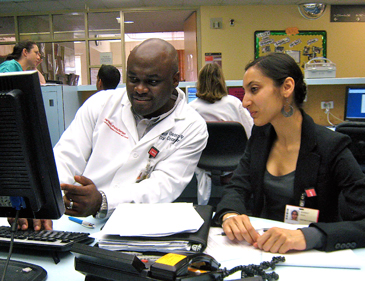
 Manmeet Kaur ’12
Journal 1
This summer, I am interning with the NewYork-Presbyterian Hospital Regional Health Collaborative (NYP-RHC), developed in association with the Columbia University Medical Center in Washington Heights-Inwood. The NYP-RHC is a population-based, collaborative model that aims to reduce health disparities and improve health outcomes. Within the NYP-RHC, I worked with the Ambulatory Care Network, which runs the hospital’s community health center practices.
The primary focus of my internship is the Targeted Care Intervention (TCI), a pilot program that focuses on managing the care of high-risk patients with multiple chronic conditions. TCI is focused on patients with complex needs in the predominantly Hispanic, Washington Heights-Inwood community. The objectives of my internship are to identify more effective patient engagement and education strategies, develop operational strategies to strengthen implementation of the TCI, and create metrics to eventually evaluate the intervention.
There is a growing need for models like TCI, especially during the transition from the hospital to the home. The growing burden of chronic illnesses, the highly fragmented nature of the US health care system, and the growing number of elderly patients compound this need. A significant indicator of quality of care with regard to ensuring effective care transitions is repeat visits to the hospital within a short period of time (re-admissions).
During the first two weeks of the internship, my supervisor arranged for me to meet with each of the leaders in the department and with directors from other programs in the hospital. Additionally, I attended a wide range of meetings with internal and external staff members in order to understand the interrelated activities that are part of the NYP-RHC and the current focus and needs of the TCI.
Finally, I spent time with three community health models at NYP to identify applicable lessons for the TCI. The first is called Win for Health, an intervention for children with asthma, designed to increase patient adherence to care regimens through a year-long engagement between community health workers, parents, and children. The second is the Heinz Project, a pilot initiative for patients with congestive heart failure, where community health workers conduct home visits and there is intensive patient engagement. Third, I learned about the HIV unit, which has achieved significant achievements in the management of complex patients living with HIV/AIDS.
Journal 2
The main goal of my internship is to develop strategies to strengthen the integration between the hospital and clinic settings and the patient’s home — through the Targeted Care Intervention (TCI) program. The hospital-to-home transition period is a particularly vulnerable time for patients. If they do not understand the nature of their condition and the steps they need to take as soon as they leave the hospital — i.e., what medications to take and when, and when to see a doctor — they are at a greater risk of being re-admitted to the hospital. This is particularly important for patients with chronic conditions.
In order to strengthen the hospital-to-home integration, I began a comparative study of the admission and discharge process at two inpatient units. The goal is to identify ways in which the TCI team of nurses and community health workers can collaborate with the inpatient teams, in order to improve the discharge process and to ensure that medically complex patients get plugged into the TCI program. The earlier the program identifies potential patients for care coordination, the more likely that TCI will be effective. Further, the transition between the inpatient setting and the TCI team needs to be as simple as possible to ensure that patients feel comfortable with the transition.
In order to conduct this study, I am creating process maps through direct observation of the process and interviews with the nurses, social workers, care coordinators, and doctors in each inpatient unit. Next, I am developing “re-design” maps with my recommendations for how the TCI can integrate into the inpatient setting and to enhance the discharge planning and education process.
In addition to my work with the NYP-RHC, the NYP Summer Administrative Internship program has organized a series of events for the interns. A speaker series, Inside NYP, is held every few weeks with a senior leader from the hospital staff or board, such as the Vice President of Medical Affairs. There are also senior leader meetings where each intern meets with four senior executives to learn about their careers and get career advice.
Another fantastic resource is that each intern is paired with a mentor from the Emerging Leaders Council, a committee of young professionals at the hospital. Many of the mentors are former interns or have experience in the department in which the intern is placed. The added benefit of the internship program is that our class is only ten people and we are placed in different departments across the organization. The experience affords a degree of intimacy and a chance to learn a lot from each other’s experiences.
Journal Entry 3
At the end of my internship, I wrapped up my studies of the inpatient units, synthesized my recommendations, and completed my dashboard of metrics for the Targeted Care Intervention (TCI). The project was particularly rewarding because I was able to work across disciplines — medicine, nursing, and administration. Further, some of my recommendations were implemented during the course of the internship.
At the end of the Administrative Internship Program there is a final presentation. Senior leadership, including the CEO, senior executives from each of the sponsoring departments, supervisors, and mentors all attend the presentation. It is an opportunity for each intern to showcase their work and learn more about diverse parts of the hospital.
The NYP-RHC has attracted the attention of policy makers and practitioners from across the country. Its efforts are of particular interest because while much of the national debate on healthcare reform has focused on Integrated Delivery Systems, such as the Mayo Clinic, Geisinger Health Systems, and Kaiser Permanente, NewYork-Presbyterian and the vast majority of US hospitals are not integrated systems. During my internship, Dr. Kavita Patel, the Managing Director for Clinical Transformation and Delivery at the Engelberg Center for Healthcare Reform at the Brookings Institute, visited the hospital to learn about the NYP-RHC. She remarked that the NYP-RHC, and programs like the TCI, will be instructional to large medical centers across the country.
My main take away from working on the TCI and the NYP-RHC is that when developing a care-delivery model for patients with complex needs, who also tend to get re-admitted to the hospital frequently, health systems need a more holistic approach to care that address the other parts of a patient’s life, including their ability to secure stable employment, access to a safe living environment, how to navigate the complex health system, and how to adhere to complicated treatment regimens.


