


 Kristen Keating ’12
Journal 1
I am spending my summer with Agora Partnerships, a nonprofit organization committed to accelerating the growth of small and medium-sized enterprises (SMEs) in Central America. Agora’s mission hinges on the idea that “impact entrepreneurs” can be the most powerful anti-poverty agents in regional economies. By creating jobs, offering employee benefits, and generally expanding the scope of what is feasible for local workers, such businesses offer the promise of sustainable, broad-based financial security to places where it has otherwise proven elusive. Agora focuses on addressing the “capital deficit” entrepreneurs in Central America encounter — deficits in financial capital, human and intellectual capital, and social capital such as mentors and networks.
The firm, founded nearly six year ago by Ben Powell ‘11, maintains two offices, one in DC where I am based, and another in Managua, Nicaragua. In DC, we focus on strategy, marketing, fundraising, and partnerships, while Managua is primarily occupied with the implementation of programming and day-to-day interactions with the entrepreneurs with whom we engage.
There is an important distinction between the efforts of microfinance institutions (MFIs), whose popularity has been explosive over the past decade, and Agora’s core work. As I have come to understand it, the distinction is this: MFIs make funds accessible to individuals and family units, under the premise that the borrower can increase the value of the money received to a degree sufficient to justify the interest rate charged. While I do think there is a lot of merit in microfinance (and a social, if not moral, imperative to make financial products available to the poor), I struggle with the idea that the majority of people — regardless of where they live or their level of education — can consistently generate a positive return on borrowed money. I have never been particularly enterprising myself, so what resonates with me about Agora’s approach is that it involves amplifying the prospects of the most entrepreneurial individuals in a community — those with big goals and the business models to justify them — in the hopes that those individuals will then employ their neighbors.
I do not believe that everyone wants to be a business owner, but I do believe that everyone wants and needs an income. Agora’s approach acknowledges the varied personalities, skills, and motives of individuals in poor areas and seeks to facilitate a business ecosystem that supports such diversity.
Importantly, all of the businesses with which Agora works have some type of intended social impact within their operations beyond job creation. I find Agora’s work fascinating, including the challenges they face ensuring that this work has material impact and evolves appropriately according to the needs of entrepreneurs and funders.
Journal 2
I am in Miami en route back to DC from Granada, Nicaragua, where Agora just hosted its inaugural Investor Conference. The conference brought together our nine Accelerator companies (those selected for an intensive six-month development program) and angel and institutional investors in the hopes of securing debt or equity financing for the companies.
Part of my focus this summer has been brainstorming ways individuals with interest in our portfolio companies can directly contribute to their growth (specifically, individuals who are not accredited investors). We have tossed around a number of scenarios, some focused on the exchange of financial capital, others on the exchange of skills or tangible resources. There is a lot of buzz around crowdsourcing, and Agora sees how such a platform would align with our mission — by bringing financial, human, and social capital to our entrepreneurs while building awareness of and involvement in the impact investing movement. But, we want to balance our excitement over the prospects of such an online service with sensitivity toward the regulatory, legal, and operational challenges that would surround building and maintaining it. We also want to make sure that whatever we create really does address the needs of our entrepreneurs and does not depart from our commitment to attend to their specific concerns rather than the broader issues of the sector as popularly perceived. The situation of the entrepreneurs had been fairly abstract for me prior to Nicaragua; the conference was an opportunity to hear firsthand about how Agora could be most useful, and I wanted to make sure I took advantage of the circumstances.
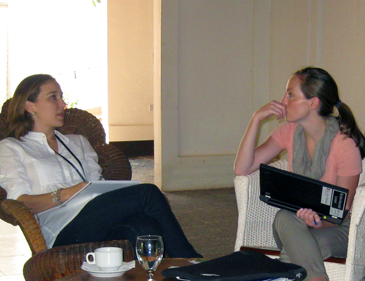
I met with the majority of the entrepreneurs and asked about their concerns. I learned that any product we build must be flexible enough to adjust to the different stages the businesses are in. Turning the specifics of what I learned into something actionable will be my focus for the remainder of the summer.
In my conversations with the entrepreneurs, and from my observations of their pitches, I gained an incredible respect for what they have built and their commitment to achieving social ends in step with growth. These good businesses deserve exposure, and so I encourage you to check each out and learn about what they are doing: Café Las Flores, CO2 Bambu, Kiej de los Bosques, Oscarito’s, Ostuma Farms, Plantech, Quetsol, Recelca, and Tegu.
As a final note, one exciting conference moment for me, outside of learning about the investments secured, was witnessing a partnership forged between Quetsol, who is providing energy solutions through solar panel kits, and CO2 Bambu, which is creating base of the pyramid housing options out of sustainable bamboo. The idea that simply getting these two entrepreneurs in the same room could catalyze a scenario where sustainable shelter is paired with a sustainable power supply — and priced in an accessible way — gives me hope that continued innovation and collaboration in the sector can usher in a new reality for those who need it most.
Journal 3
In my second journal entry — written on my return from our Investor Conference in Nicaragua — I mentioned that the rest of my summer with Agora Partnerships would be devoted to distilling what I had heard from the entrepreneurs about their needs, devising possible solutions to address these, and determining how such solutions could be integrated into Agora’s programming.
I want to recap how some of this panned out:
- Many of the entrepreneurs highlighted challenges in finding, hiring, and training talent at the management level. I worked upon my return with another intern to put together a grant proposal that would fund capacity development programming for the next Accelerator class. By using Agora’s resources to help identify talent, channeling this talent to our entrepreneurs, and adding training specifically for this tier of employees, we can extend Agora’s impact and help promote not only growing ventures, but sustainable businesses.
- I continued to work with our director of strategic projects on the website profiles we built for our entrepreneurs to make sure they effectively convey, to a wide audience, the impact and growth trajectories of the businesses.
- I worked with interns in our Managua office to help refine elements of the Mentor Program that is to be put in place for the next Accelerator class. It came through in my conversations that the hurdles our entrepreneurs encounter as business leaders are sufficiently varied to suggest that Agora would be most useful if we identified mentors who could empathize with the entrepreneurs.
- The brainstorming surrounding how non-accredited individuals could contribute directly to Agora entrepreneurs evolved into several outlined project ideas. The majority of these involved leveraging peer-funding platforms — those designated for donations as well as those facilitating debt and equity financing — and ensuring our entrepreneurs know about these platforms. How Agora continues to innovate when it comes to linking entrepreneurs with interested individuals will continue to be of great interest to me.
My summer with Agora was incredibly eye-opening. I valued the insights offered by my co-workers and the honest exchanges I was able to have with our talented entrepreneurs.


