
Navigating Zimbabwe’s Economic Crisis to Achieve Growth
Our team worked on a growth strategy for Microhub, a Harare-based financial institution that provides loans to small and medium-sized enterprises (SMEs).
Before joining our client in Harare, we had closely followed the news coverage about Zimbabwe’s rising inflation and local currency uncertainties. But it wasn’t until we landed at Robert Mugabe Airport, named for the country’s recently overthrown leader, that the full extent of the crisis became evident.

Facing severe fuel shortages, cars were queued by the hundreds at gas stations in Harare, waiting days for the next shipment of government-subsidized gasoline. Zimbabwe’s currency inflation and dwindling supply of highly coveted US dollars made essential imports like food more expensive. Higher import prices shuttered businesses and hurt everyone but the politically connected.
Against the backdrop of this crisis, our Pangea team was in Harare to develop a growth strategy for Microhub, a leading financial institution in Zimbabwe that lends to hundreds of SMEs across the country. With small businesses and consumers suffering from the worst currency crisis in a decade, it was an exceedingly tough environment for a financial firm like Microhub. Our task was therefore challenging: we needed to create a strategy that would help the company weather this crisis, grow their top line, and position the firm to emerge stronger when the economy recovered.
Over the course of a week, we worked out of Microhub’s headquarters in downtown Harare and traveled by pickup truck to satellite offices in Chinhoyi, Kadoma and Mutoko. We met with Microhub’s loan officers and key executives to map out the firm’s operations, while interviewing dozens of customers to better understand their needs and perceptions of our client.

We came away from these meetings with some important (and at times surprising) insights. For example, after sitting down with the operations team and reviewing financials, we realized the satellite office model was a much more profitable blueprint for future growth, rather than replicating their full-service flagship location. Meetings with customers revealed that Microhub branded merchandise – something as simple as a tee-shirt or cap – was so sought after by customers that it could be used as a reward to incentivize high-quality customer referrals. These insights and others illuminated growth levers in an otherwise adverse economic environment.
As a culmination to our engagement, we attended Microhub’s annual offsite meetings to present our growth strategy. Our recommendations included a geographic expansion plan to the country’s south that would minimize capital expenditures. We also proposed ideas to diversify their product offering to grow revenues and broaden their customer base. We then concluded our presentation with a synthesis of key customer feedback, and some corresponding strategies to boost customer acquisition efforts.

Our presentation sparked a lively discussion among the entire executive team, which in turn yielded several concrete decisions for their coming year. Not only were we able to deliver real insights and impact to our client, but we found the entire experience — our meetings with Microhub staff, our conversations with small business owners across Zimbabwe — to be a great opportunity for our own development. We had stepped into a completely new sector and geography, learned a great deal from our gracious hosts, and improved our understanding of some of the unique business challenges in markets plagued by significant political and economic risks. We left Harare with a much greater appreciation for Microhub’s mission and a desire to soon return to the region for similar work.
– William Gangware ’19, Brendon Earle ’19, and Charlie Drain ’19
Using AI to Help the Poultry Industry in Manila
Iamus is a designer and manufacturer of AI-enabled agricultural robots that assist poultry farmers in carrying out manual tasks and facility maintenance traditionally performed by human labor. These tasks are crucial to poultry yield, margins, and animal health, yet are currently done inefficiently and would be greatly improved with the use of robotics. With Iamus, human labor can be assigned to more directed and higher complexity actions. Iamus has an Irish team and is headquartered in Manila, Philippines.
Iamus had raised about £500,000 in seed funding from strategic investors but was preparing to pitch to non-strategic investors and needed our help on messaging it to investors that were not necessarily familiar with the industry. They had found that they had difficulty communicating the business value of the company. They also wanted us to perform a competition and market analysis and model future growth. As consultants, we were able to look at the business problem and company from an outsider’s perspective and help Iamus craft a message for potential investors. The additional analysis and modeling we performed was included in the new pitch deck as well.

The quality of assignment felt like a real consulting firm could have been brought in to do the exact same work. That, combined with the cutting edge nature of the company and an interesting emerging market like the Philippines, made this one of the most rewarding experiences I had during my first year at Columbia Business School. I also had the professional development opportunity to lead a team of two teammates during the engagement and spend quality time with them in Manila (I did not know them especially well going in). For those without a consulting background, Pangea can truly mimic the experience — the energy around delivering excellent deliverables to the client on a tight schedule, the intellectual freedom to develop the analyses as you see fit, and the reward of knowing that your work has made an impact.

– David Wu ’20
Have You Ever Been to Ghana?
I traveled with a group of three friends to Ghana to support a local NGO providing healthcare services to rural communities. This trip was an amazing source of inspiration. Among several learnings, I distilled some key learnings that entrepreneurs can find useful.
Reality Strikes You
When we first started working with our NGO from across seas, we received a broad target of our project and some initial data. We scheduled some calls to learn context and request additional data — in three calls we developed a few initial hypotheses on how we could solve the problem before traveling to Ghana.
Before we arrived in Ghana, we had looked up the distance between neighboring villages and, given that we had seen roads connecting them on Google Maps, we believed that transfers between villages should take no more than 5’. Yet, it took us at least 20’ to travel between villages — the road network in rural Ghana lacks basic infrastructure and can be impacted even by minor rain.

This happens frequently in the customer discovery process for entrepreneurs. Startups start interviewing potential clients and experts to collect as much info and data as possible before launching a product. And then, once the product is ready, the actual sales are much lower compared to the projected growth. Skilled entrepreneurs collect enough data and generate meaningful insights from the customer discovery process. But many times, successful entrepreneurs need subject-matter expertise to convert projections to actual sales, even if the product is a pain-killer in theory.
As an entrepreneur, it is not a pre-requisite to have experience in the industry you are targeting; but if you don’t, make sure you on-board a team of advisors who do!
What Makes People Smile?

Ghana lives and breathes football (I refer to the sport played without hands, only feet, thus football). It’s surprising how massive the impact of British football is in the country. Most people wear jerseys of their favorite teams (not surprisingly, traditional brands like Manchester United, Liverpool, Arsenal, and Chelsea dominate). There’s a small, custom football field on every street corner, with myriad football players in it. Football there is as inclusive as it gets: kids between 10- and 15-years-old play together in the same pitch.
Football is unique in Ghana because it unites people. In most developed countries, football is still loved as a religion, but it’s also a source of rage and criminal activity: armies of hooligans vandalizing cities and shady actors making millions in illegal betting. Yet, in Ghana, football is a religion that promotes inclusion and does not tolerate violence. Football is the source of an unprecedented smile rate and a key source of socializing and having fun.
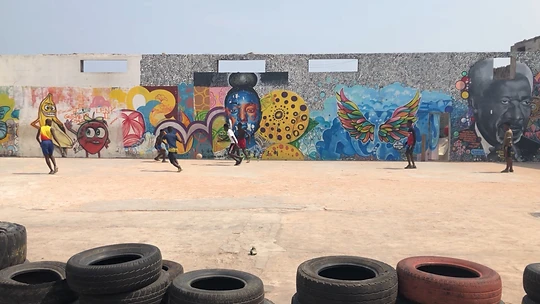
When building your startup, you need to find your team’s “football,” something that inspires your employees to achieve your vision and improve their work lives.
At foodpanda, we had a team that was >80 percent international. We all enjoyed the multi-culti environment in Berlin and we felt proud that foodpanda had business in over 40 countries worldwide. Our diversity united us! That’s why we had so much fun playing our weekly trivia game with questions from all over the world and participating in (very intimidating) themed karaoke nights.
Sanne Manders, COO of flexport, has helped the company build a very strong culture of collaboration and motivation by introducing a cross-functional organizational structure called “squad.” Horizontal squads bring together people from sales, product and operations, and vertical squads bring together people from flexport’s customer segments: small, medium, and larger clients. This sophisticated organizational structure allows squads to have their own (ridiculous) names and outfits and compete in internal fantasy leagues. They make fun of other teams by creating custom slack emojis and enjoy team dinners.
This squad structure has helped flexport make sure that information is diffused among teams and customer segments, which is a huge challenge in startups that are expanding at the rate of flexport. In the flexport world, sales and product people are friends because the culture (and org structure) give them the opportunity to feel part of the same family.
Key Takeaway: Stay Positive!
People in Ghana live in conditions that Westerners would find challenging, yet, they manage to live joyfully. Their mentality towards life and the challenges that face them is truly unique — and we all need to learn from them! If you get the chance, try to visit Ghana and learn from locals and their amazing culture, I promise the trip will be a life-changing experience.
– Agapitos Diakogiannis ’20